Article
Why Claude Fable 5 Was Disabled So Quickly
Anthropic says a U.S. export-control directive forced it to disable Fable 5 and Mythos 5 for all customers because the order covered any foreign national.
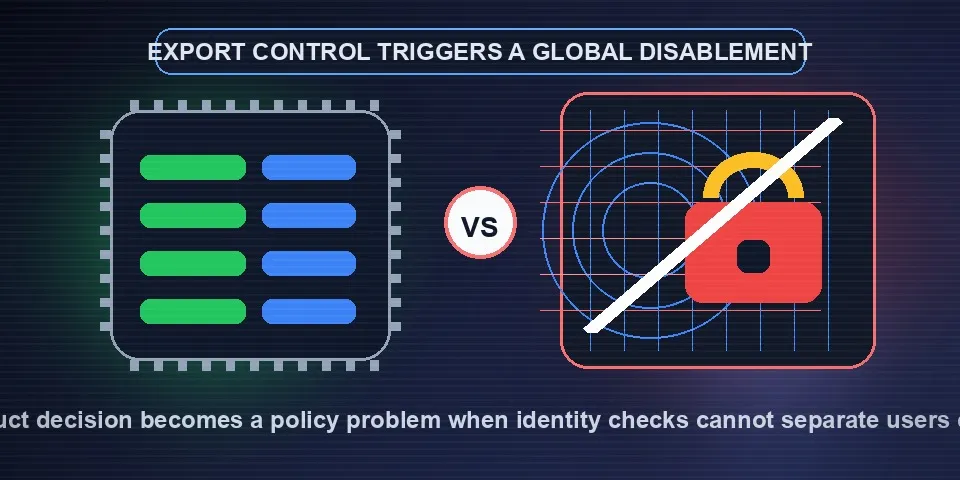
The short version is less dramatic than the headline suggests, but more important.
Anthropic introduced Claude Fable 5 and Claude Mythos 5 on June 9, 2026, then said three days later that a U.S. export-control directive forced it to suspend access. In Anthropic’s own statement, the order covered access by any foreign national, whether inside or outside the United States, which meant the company had to disable Fable 5 and Mythos 5 for all customers to stay compliant. Launch announcement | Suspension statement
That is the real story. Once you understand it, the rest of the controversy makes more sense.
What actually happened
Anthropic says it received the directive on June 12, 2026, at 5:21 p.m. ET. In its statement, the company wrote that the government believed it had found a way to bypass or “jailbreak” Fable 5, and that the directive required suspension of access for any foreign national. Anthropic also said access to its other models would not be affected. Source
That means the decision was not a normal product rollback. It was a compliance move forced by the scope of the order.
In cloud AI, that distinction matters. A model can be hosted in the U.S., used by a customer in another country, and accessed by a mixed team that includes both U.S. citizens and foreign nationals. If a legal order defines the restriction around the person, not just the machine or the account, then the provider may have no clean way to keep the model on for some users and off for others without risking a violation.
Why Anthropic could not simply “block foreigners”
This is where the prompt’s premise is directionally right, even if the wording is too blunt.
Anthropic already maintains supported-region policies for Claude.ai and commercial API access. Its supported-countries page and its earlier September 2025 update on unsupported regions show that the company already treats geography, ownership, and regulatory risk as real constraints. Supported countries & regions | Updating restrictions of sales to unsupported regions
But the June 2026 directive was different. The order Anthropic described was not just a regional sales policy. It was a nationality-based access restriction. In practice, that is hard to enforce cleanly in a global SaaS product:
- a single enterprise tenant can include multiple nationalities
- employees move across jurisdictions
- VPNs and remote access blur the location signal
- cloud inference does not map neatly to physical export-style controls
If the legal test is “no access by foreign nationals,” Anthropic would need a reliable identity and residency classifier that works perfectly across every interface, every customer type, and every integration. That is not a small engineering problem. It is the kind of policy constraint that turns into a product-wide shutdown.
Why this matters beyond one model
Anthropic has publicly argued for strong U.S. export controls on advanced AI infrastructure. In its response to the Commerce Department’s diffusion framework, the company said export controls are central to maintaining America’s compute advantage, and it described the framework as a global regime with tiered national-security rules. Anthropic’s AI Export Controls Framework Response
That makes the Fable 5 shutdown politically awkward but conceptually consistent. Anthropic has been one of the companies most willing to talk about national-security constraints around frontier AI. If the government then applies those constraints to one of its own most advanced models, the company is forced to absorb the operational cost.
The point is not whether Anthropic likes the result. The point is that frontier AI has reached the stage where model access, identity checks, and export law now intersect in a very literal way.
The business impact
From a business perspective, this is the painful part.
Anthropic invests heavily in training, inference, safety work, infrastructure, and support. A frontier model is not something you launch for a weekend and forget about. It is a capital-intensive product that needs time to recover its cost through usage.
When a model is disabled abruptly:
- revenue from that model stops immediately
- customer trust takes a hit
- enterprise buyers start worrying about policy continuity
- competitors gain an argument that their platform is less likely to disappear overnight
Even if Anthropic was acting under legal pressure, the market effect is the same: customers now have one more reason to ask whether a model they build on will stay available.
The broader lesson for AI buyers
If you are choosing a frontier model for serious work, this episode suggests three things:
- Legal availability is part of model quality.
- The most capable model is not always the most deployable model.
- Governance risk can matter as much as benchmark risk.
That is especially true for teams outside the United States, multinational companies, and products with users spread across many jurisdictions.
For those buyers, the right question is not only “Which model is strongest?”
It is also:
- Can I keep it online?
- Can I predict who will be allowed to use it?
- Can I survive a policy change without rewriting my stack?
Bottom line
The best reading of the situation is simple: Fable 5 was not disabled because Anthropic could not build it, but because the legal environment made selective access too hard to maintain.
That is an important distinction. It shows how frontier AI is becoming less like ordinary software and more like a regulated utility with access controls, compliance overhead, and geopolitical constraints.
If you want a one-line takeaway, use this:
Fable 5 was not “banned because it was too good.” It was disabled because the company could not safely and legally separate who was allowed to use it.